How to Sleep With a Frozen Shoulder - 10 Evidence-Based Tips for Better Rest and Less Night Pain
Compartir
Why Does a Frozen Shoulder Feel Worse at Night?
If you’ve ever found yourself staring at the ceiling at 2 a.m., carefully trying to roll over without sending a sharp ache through your shoulder, you’re not alone.
For many people living with frozen shoulder, nighttime can be the hardest part of the day.
The pain that felt manageable while answering emails, cooking dinner, or taking a walk suddenly becomes much more noticeable the moment the lights go out. Finding a comfortable sleeping position feels almost impossible. Every small movement—reaching for a blanket, adjusting a pillow, or simply turning onto your side—can wake you up.
Poor sleep then creates another problem.
After a restless night, many people notice that their shoulder feels even stiffer the next morning. Fatigue also changes how we perceive pain, making discomfort seem more intense than it did the day before. It’s a cycle that’s frustratingly common: shoulder pain interrupts sleep, poor sleep increases pain sensitivity, and the next night becomes even more difficult.
The good news is that while there isn’t a single overnight solution for frozen shoulder, there are several practical strategies that may help you sleep more comfortably and wake up feeling less stiff.
This guide explains what current research and clinical recommendations suggest—from choosing a better sleeping position to understanding how heat, gentle movement, and wearable recovery technologies may fit into a bedtime routine.
What Is Frozen Shoulder?
Frozen shoulder, also known as adhesive capsulitis, is a condition that causes pain and a gradual loss of movement in the shoulder joint.
Unlike soreness after a workout, frozen shoulder develops slowly. At first, you might notice discomfort when reaching overhead or fastening a seatbelt. Over time, even simple tasks like putting on a jacket or washing your hair can become difficult.
According to the American Academy of Orthopaedic Surgeons (AAOS), frozen shoulder typically progresses through three overlapping stages.
The Freezing Stage
Pain gradually increases, especially during movement and at night. As discomfort worsens, people naturally begin using the shoulder less.
This stage may last several months.
The Frozen Stage
Pain often becomes less severe, but stiffness becomes much more noticeable. The shoulder loses range of motion, making everyday activities increasingly challenging.
The Thawing Stage
Movement slowly begins to return.
Recovery can take months, and for some people, more than a year.
Although frozen shoulder often improves over time, maintaining comfortable movement throughout the recovery process remains an important goal.
Why Is Frozen Shoulder Worse at Night?
One of the most common questions people ask is surprisingly simple:
“Why does my shoulder hurt so much more when I’m trying to sleep?”
Researchers believe several factors work together.
First, your shoulder naturally stays still for much longer at night than during the day.
Even small daytime activities—walking, reaching, changing posture—keep the joint moving. Once you lie down for several hours, stiffness tends to become more noticeable.
Second, sleeping positions can place additional pressure on already sensitive tissues.
If you accidentally roll onto the affected shoulder, your body weight compresses muscles and soft tissues around the joint, often triggering pain strong enough to wake you.
Even sleeping on the opposite side isn’t always comfortable if the affected arm hangs unsupported.
Finally, our perception of pain changes at night.
With fewer distractions, discomfort naturally becomes more noticeable. Research has also shown that poor sleep and pain influence one another in both directions. In other words, pain disrupts sleep, and insufficient sleep can increase pain sensitivity the following day.
Understanding this cycle helps explain why improving sleep isn’t just about getting more rest—it’s also an important part of managing everyday shoulder discomfort.
1. Avoid Sleeping Directly on the Painful Shoulder
This sounds obvious, yet many people unknowingly roll onto the affected shoulder during the night.
When that happens, the body’s weight places additional pressure on muscles, tendons, and the shoulder capsule, often making pain significantly worse.
Whenever possible, avoid sleeping directly on the painful side.
Instead, choose one of these positions:
- Sleep on your back with your affected arm supported by a pillow.
- Sleep on your unaffected side while placing a pillow in front of your body to support the affected arm.
The goal isn’t to keep the shoulder completely still.
It’s simply to reduce unnecessary pressure while allowing the joint to remain in a relaxed position.
2. Let Your Pillow Support Your Arm—Not Just Your Head
Many people spend time choosing the right pillow for their neck but forget about supporting the shoulder itself.
Without support, the weight of the arm pulls gently on the shoulder joint throughout the night. For someone with frozen shoulder, even this small amount of tension may become uncomfortable after several hours.
A simple pillow can make a surprising difference.
If you’re sleeping on your back, place a pillow beneath your forearm so your elbow rests slightly higher than your waist.
If you’re sleeping on your unaffected side, hug a pillow and allow your affected arm to rest on top of it.
This keeps the shoulder in a more neutral position instead of letting it hang forward.
Many physical therapists recommend this simple adjustment because it’s inexpensive, easy to try, and often improves comfort immediately.
3. Consider Sleeping Slightly Reclined
For some people, lying completely flat increases shoulder discomfort.
Sleeping in a slightly reclined position—using an adjustable bed or a recliner chair—may reduce pressure around the shoulder while making it easier to change positions during the night.
This approach isn’t necessary for everyone, but it’s commonly recommended during periods when nighttime pain is particularly severe.
Even stacking several firm pillows behind your back can sometimes provide enough support to create a more comfortable angle.
4. Use Gentle Heat Before Bed to Help Your Shoulder Relax
If your shoulder feels stiff rather than swollen, applying gentle heat before bed may help make the evening more comfortable.
Heat has been used in physical therapy for decades, particularly for muscles and joints that feel tight after prolonged inactivity. While it isn’t a treatment for frozen shoulder itself, warmth may help relax surrounding muscles, improve the feeling of flexibility, and make it easier to perform gentle mobility exercises before sleep.
Think about what happens on a cold winter morning.
Your first few movements often feel slow and restricted. As your body warms up, movement becomes easier and more natural.
Shoulder stiffness often behaves in a similar way.
A warm shower, a heating pad, or a warm compress before bed may help your shoulder feel less guarded, making it easier to settle into a comfortable sleeping position.
That doesn’t mean hotter is better.
Heat should feel comfortably warm—not painfully hot. Most physical therapists recommend applying heat for about 15 to 20 minutes before gentle stretching or relaxation.
If your shoulder recently became injured, appears swollen, or feels noticeably warm to the touch, cold therapy may be more appropriate during the first couple of days. Once acute inflammation has settled, heat is generally the option people find more comfortable for ongoing stiffness.
Quick Take
Heat isn’t about “fixing” a frozen shoulder overnight. Its value lies in helping muscles relax so that bedtime movements and gentle stretching feel more comfortable.
5. Don’t Stretch Aggressively Before Going to Sleep
When movement becomes limited, it’s tempting to believe that stretching harder will speed up recovery.
Unfortunately, frozen shoulder rarely works that way.
One of the most common mistakes people make is forcing the shoulder beyond its comfortable range, especially before bed. While mild stretching can help maintain mobility, aggressive stretching often has the opposite effect, irritating already sensitive tissues and making it even harder to sleep.
Instead, aim for slow, controlled movements.
A few minutes of gentle mobility is usually enough.
Examples include:
- Pendulum exercises
- Assisted shoulder elevation using the opposite arm
- Shoulder blade squeezes
- Gentle wall walks
None of these exercises should produce sharp or lingering pain.
A useful rule is this:
Stretch until you feel resistance—not pain.
The goal before bedtime isn’t to increase flexibility dramatically.
It’s simply to help the shoulder feel less stiff before you lie down for several hours.
6. Small Movements During the Day Can Make Nights Easier
Many people focus only on what they should do immediately before bed.
But nighttime comfort often begins much earlier.
When the shoulder remains almost completely still throughout the day, stiffness tends to build gradually. By bedtime, even simple movements can feel uncomfortable.
That doesn’t mean you should push through pain or continue activities that aggravate your shoulder.
Instead, try to avoid long periods without moving it at all.
Simple daily habits can make a meaningful difference:
- Stand up and change position regularly if you work at a desk.
- Let your affected arm participate in light daily activities whenever comfortable.
- Perform a few gentle range-of-motion exercises during short breaks.
- Avoid keeping the shoulder in one position for hours at a time.
Think of movement as maintenance rather than exercise.
You’re reminding the joint that it can still move, even if the range is temporarily limited.
7. Creating a Bedtime Recovery Routine
One reason frozen shoulder feels frustrating is that progress often comes slowly.
There isn’t a single exercise, pillow, or therapy that changes everything overnight.
What often makes the biggest difference is having a routine you can realistically repeat.
Rather than waiting until the pain becomes severe each evening, many people find it helpful to follow the same sequence before bed.
A simple routine might look like this:
Step 1 — Five minutes of gentle shoulder mobility
Start with slow pendulum movements, shoulder rolls, or light range-of-motion exercises. The purpose is simply to loosen the joint—not to challenge it.
Step 2 — Apply gentle warmth
After moving the shoulder, spend 15 to 20 minutes using gentle heat while reading, listening to music, or winding down for the evening.
This is where wearable recovery devices can fit naturally into a bedtime routine.
Unlike a traditional heating pad that often slips out of place or requires you to remain close to a power outlet, a wearable shoulder wrap stays positioned over the shoulder while allowing you to sit comfortably in your favorite chair or move around the house.
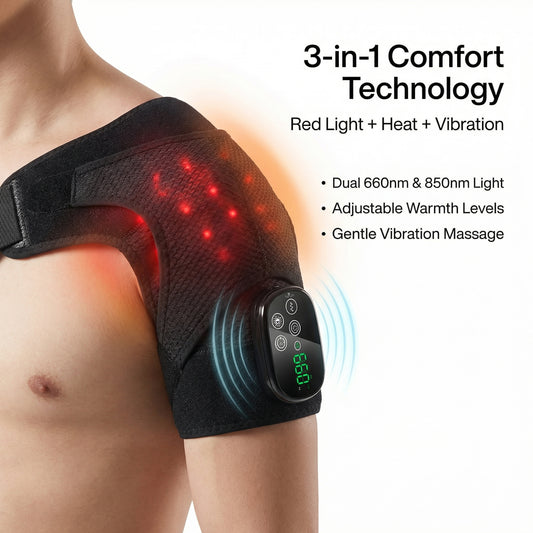
One example is the Nutvrliy Red Light Therapy Shoulder Wrap, designed as a daily recovery tool rather than a medical treatment.
Its ergonomic wrap design comfortably fits either shoulder and combines several features that many people already use separately:
- Dual-chip 660nm and 850nm LEDs, providing broad red and near-infrared light coverage across the shoulder.
- Three adjustable heat settings (45–60°C) for personalized warmth based on individual comfort preferences.
- High-frequency vibration massage with three intensity levels, helping ease the feeling of muscle tension after work, exercise, or long hours at a desk.
- A cordless 5000mAh rechargeable battery, allowing flexible use without remaining connected to a wall outlet.
- Built-in timer options (20, 30, or 45 minutes) that fit naturally into an evening recovery routine.
Rather than replacing physical therapy, exercise, or guidance from your healthcare provider, a wearable recovery wrap can make it easier to incorporate warmth, relaxation, and recovery into everyday life—especially for people who struggle to stay consistent with traditional recovery tools.
Step 3 — Prepare Your Sleeping Position
Before getting into bed, arrange your pillows so your shoulder is already supported.
Taking thirty seconds to position your arm comfortably often prevents repeated adjustments during the night.
8. More Than the Shoulder: Why Your Neck and Upper Back Matter
One thing many people don’t realize is that frozen shoulder rarely affects only the shoulder.
When shoulder movement becomes limited, the rest of the body quietly begins to compensate.
You might shrug your shoulder more when reaching for a shelf.
Your neck may tense while trying to lift your arm.
Your upper back may become stiff after weeks of moving differently without even noticing it.
Over time, these compensations can create discomfort beyond the shoulder itself.
This is one reason many rehabilitation programs focus not only on the shoulder joint, but also on the surrounding muscles that support healthy movement.
For people who notice tightness extending into the neck or upper back, recovery strategies that address a broader area—such as gentle mobility, posture awareness, warmth, or wearable wraps that extend beyond the shoulder alone—may feel more comfortable than treating a single point in isolation.
After all, the shoulder doesn’t work by itself.
It works as part of an entire movement system.
9. Where Does Red Light Therapy Fit Into a Frozen Shoulder Recovery Routine?
If you’ve been researching frozen shoulder, you’ve probably come across red light therapy.
Over the past decade, it has become increasingly common in physical therapy clinics, sports medicine practices, and home recovery devices. At the same time, the growing number of consumer products has made it difficult to separate evidence from marketing.
So what does the research actually say?
The first thing to understand is that red light therapy isn’t intended to “break up” a frozen shoulder or replace medical care.
Instead, researchers have been studying photobiomodulation (PBM)—the use of specific wavelengths of red and near-infrared light—as a way to support normal cellular activity involved in recovery.
Unlike a heating pad, which primarily produces warmth, red light therapy works through light energy.
Laboratory studies suggest that certain wavelengths are absorbed by structures inside cells called mitochondria, which play a central role in producing ATP—the energy source that powers many cellular processes.
Researchers continue to investigate exactly how this influences tissue recovery, but current evidence suggests that photobiomodulation may help support normal healing processes under appropriate conditions.
For musculoskeletal conditions, the strongest body of research has focused on wavelengths between approximately 630 and 850 nanometers, particularly visible red light around 660nm and near-infrared light around 850nm.
These wavelengths are frequently used because they interact with tissue differently.
Visible 660nm red light primarily affects more superficial tissues, while 850nm near-infrared light is able to penetrate deeper beneath the skin. Rather than competing with one another, they are often combined to provide complementary coverage across different tissue depths.
For that reason, many modern rehabilitation devices now incorporate both wavelengths instead of relying on only one.
It’s important to keep expectations realistic.
Red light therapy is not a shortcut.
It works best when viewed as one part of a broader recovery strategy that includes appropriate movement, sleep, physical therapy when needed, and guidance from your healthcare provider.
Why Consistency Matters More Than Intensity
One of the biggest challenges with frozen shoulder is not finding the “perfect” treatment.
It’s staying consistent long enough to benefit from it.
Recovery often takes months rather than weeks. During that time, many people gradually stop doing the small things that once seemed manageable—stretching, applying heat, or performing mobility exercises—simply because they become inconvenient.
That’s where wearable recovery tools can offer a practical advantage.
Instead of requiring separate devices for heat, massage, or light therapy, combining multiple recovery methods into one routine may make it easier to stay consistent over time.
For example, after completing a few minutes of gentle shoulder mobility in the evening, some people prefer using a wearable shoulder wrap while reading, watching television, or relaxing before bed.
This approach allows recovery to become part of an existing habit rather than another task that needs to be scheduled.
A Wearable Recovery Tool Designed for Everyday Comfort
One example is the Nutvrliy Red Light Therapy Shoulder Wrap.
Rather than focusing on a single recovery modality, the wrap combines several features commonly used in daily shoulder recovery into one wearable design.
Its dual-chip LED system delivers both 660nm red light and 850nm near-infrared light, providing balanced light coverage across the shoulder region. Compared with single-wavelength designs, using both wavelengths allows the device to address tissues at different depths while maintaining even illumination across the treatment area.
To complement the light therapy, the wrap also includes three adjustable heat settings (45–60°C). Gentle warmth before bed may help relax surrounding muscles, making it easier to perform light stretching or settle into a comfortable sleeping position.
Integrated high-frequency vibration massage provides another layer of relaxation. While vibration is not intended to treat frozen shoulder itself, many people find it helpful for easing the feeling of muscle tightness that develops in the neck, upper back, and surrounding shoulder muscles after a long day.
The ergonomic wrap is designed to fit either shoulder securely, allowing it to remain comfortably in place without needing to be held by hand. Combined with a 5000mAh rechargeable battery, USB-C charging, and selectable 20-, 30-, or 45-minute timer settings, it fits naturally into an evening recovery routine at home.
Most importantly, the wrap is intended to support healthy recovery habits—not replace them.
When combined with gentle mobility, proper sleeping support, and regular movement throughout the day, wearable recovery technologies can make those habits easier to maintain consistently.
10. Heat or Ice Before Bed?
Another question that frequently comes up is whether you should use heat or ice before going to sleep.
The answer depends on what your shoulder is experiencing.
If you’ve recently injured your shoulder and it’s swollen, warm to the touch, or visibly inflamed, cold therapy is generally recommended during the first 24–48 hours. Ice may help reduce swelling and temporarily numb pain during this early stage.
Frozen shoulder, however, is different from an acute injury.
Many people experience ongoing stiffness rather than active swelling. In these situations, gentle heat is often preferred because it may help relax muscles and make movement feel more comfortable before bedtime.
That doesn’t mean heat is always the right answer.
If you’re unsure why your shoulder hurts, or if your symptoms suddenly worsen, it’s worth discussing the situation with your healthcare provider before starting any new recovery routine.
A useful way to think about it is this:
- Ice is commonly used to calm an acute injury.
- Heat is commonly used to prepare a stiff shoulder for comfortable movement.
For many people living with frozen shoulder, the goal before bed isn’t to reduce swelling—it’s to make it easier to move, relax, and sleep.
When Should You Seek Medical Care?
Although frozen shoulder often improves gradually, not every painful shoulder is frozen shoulder.
Arrange a medical evaluation if you experience any of the following:
- Shoulder pain after a fall, collision, or other significant injury.
- Sudden inability to lift the arm.
- Fever, redness, or significant swelling around the shoulder.
- Numbness or weakness extending into the hand or arm.
- Pain that continues to worsen despite several weeks of appropriate self-care.
- Night pain accompanied by unexplained weight loss or other concerning symptoms.
A healthcare professional can determine whether your symptoms are caused by frozen shoulder or another condition, such as a rotator cuff injury, arthritis, or cervical spine disorder.
Remember that recovery advice found online—including this article—is intended for general education and should never replace an individualized medical assessment.
Quick Take
Better sleep with a frozen shoulder rarely comes from one single solution. A combination of thoughtful sleeping positions, gentle movement, appropriate heat, realistic expectations, and consistent recovery habits often provides the greatest benefit over time. Wearable tools such as the Nutvrliy Red Light Therapy Shoulder Wrap are best viewed as supportive additions to that routine—not substitutes for movement, physical therapy, or professional medical care.
Frequently Asked Questions
Can I Sleep on the Affected Shoulder?
It’s generally best to avoid sleeping directly on the painful shoulder.
Lying on the affected side increases pressure on the shoulder joint and surrounding soft tissues, which can make pain more noticeable and cause you to wake during the night.
If possible, sleep on your back with your arm supported by a pillow, or sleep on your unaffected side while hugging a pillow to keep the painful shoulder in a neutral position.
Is It Better to Sleep Sitting Up?
For some people, yes.
Sleeping in a slightly reclined position may reduce pressure on the shoulder and make it easier to change positions during the night.
This is especially common during the more painful “freezing” stage of frozen shoulder.
An adjustable bed or a recliner isn’t necessary for everyone, but many patients find temporary relief from sleeping at a slight incline.
Should I Stretch Before Going to Bed?
Gentle stretching may help.
Aggressive stretching usually doesn’t.
The goal before bedtime isn’t to force more range of motion—it’s to reduce stiffness and help the shoulder relax before sleep.
Simple pendulum exercises or light range-of-motion movements are generally better choices than deep stretching that causes significant pain.
Is Heat Better Than Ice for Frozen Shoulder?
Both can have a place, but they serve different purposes.
Ice is typically used shortly after an acute injury to help reduce swelling and numb pain.
Frozen shoulder, however, is usually characterized by long-term stiffness rather than recent trauma.
For many people, gentle heat before bed feels more comfortable because it helps relax surrounding muscles and prepares the shoulder for movement.
If your shoulder is swollen, unusually warm, or you’ve recently experienced an injury, consult your healthcare provider before using heat.
Can Red Light Therapy Help Frozen Shoulder?
Research into photobiomodulation (PBM) continues to grow.
Some clinical studies suggest that red and near-infrared light may support pain management and physical function in certain musculoskeletal conditions.
However, red light therapy should not be viewed as a standalone treatment for frozen shoulder.
Instead, it may be most helpful when incorporated into a broader recovery plan that includes appropriate exercise, physical therapy when needed, good sleep habits, and guidance from your healthcare provider.
How Long Does Frozen Shoulder Usually Last?
Recovery varies from person to person.
Many people experience symptoms for one to three years, although the condition often improves gradually over time.
The three classic stages—freezing, frozen, and thawing—don’t have a fixed timeline, and some individuals recover faster than others.
Early guidance from a healthcare professional may help you manage symptoms and maintain shoulder mobility throughout the recovery process.
Can I Use a Heated Shoulder Wrap Every Day?
For many healthy adults, gentle heat can be incorporated into a daily recovery routine, provided the product is used according to its instructions.
A wearable device such as the Nutvrliy Red Light Therapy Shoulder Wrap is designed for short sessions rather than continuous use. Its built-in 20-, 30-, and 45-minute timers help encourage appropriate session lengths, while adjustable heat settings allow users to choose a comfortable level of warmth.
Avoid using heat over broken skin or areas with reduced sensation, and discontinue use if you notice excessive discomfort or irritation.
What If My Shoulder Pain Keeps Getting Worse?
Frozen shoulder usually changes gradually.
If your pain suddenly becomes much more severe, follows a fall or injury, or is accompanied by fever, swelling, significant weakness, or numbness, seek medical evaluation promptly.
These symptoms may indicate a different condition that requires specific treatment.
Key Takeaways
Living with a frozen shoulder can make every night feel longer than it should.
The constant search for a comfortable position, interrupted sleep, and morning stiffness can gradually affect your energy, work, and daily routine. While there isn’t a quick fix, small changes often make a meaningful difference when practiced consistently.
Current evidence suggests that improving sleep with frozen shoulder is less about finding one perfect solution and more about combining several supportive strategies:
- Sleep in a position that reduces pressure on the affected shoulder.
- Support your arm with pillows to keep the joint in a relaxed, neutral position.
- Perform gentle mobility exercises instead of forceful stretching before bed.
- Use comfortable warmth when stiffness—not acute swelling—is your primary concern.
- Stay active during the day to prevent the shoulder from becoming even more restricted.
- Build a simple evening routine that you can realistically maintain.
Recovery tools can also play a supporting role.
For people who enjoy incorporating warmth, massage, or light therapy into their evening routine, wearable devices such as the Nutvrliy Red Light Therapy Shoulder Wrap provide a convenient way to combine these comfort-focused features into a single cordless design. Rather than replacing medical treatment or physical therapy, they are best viewed as practical tools that can help make healthy recovery habits easier to repeat.
Perhaps the most important thing to remember is this:
Frozen shoulder almost always improves with time.
Progress is rarely measured in days—it is measured in weeks and months. Staying patient, protecting your sleep, and maintaining gentle daily movement often contribute far more to long-term recovery than searching for a single “miracle” treatment.
Good sleep doesn’t cure a frozen shoulder.
But better sleep can make the journey through recovery much more manageable.
Editor’s Note
Medical Disclaimer
This article is intended for educational purposes only and should not be considered medical advice. If you experience severe shoulder pain, sudden loss of movement, fever, significant swelling, numbness, or symptoms following an injury, consult a qualified healthcare professional promptly. Always follow the advice of your physician or physical therapist regarding diagnosis and treatment.