What Is the Fastest Way to Relieve Hip Pain? - Evidence-Based Strategies That Actually Help
Compartir
Hip Pain Doesn’t Wait for a Convenient Time
Hip pain has a way of interrupting ordinary moments.
Sometimes it appears after a long day sitting at a desk. Sometimes it’s the soreness you notice after an intense hike or a weekend of gardening. For others, it’s the stiffness that greets them when they get out of bed in the morning, making those first few steps slower than usual.
Regardless of when it begins, the first question is often the same:
“What’s the fastest way to relieve hip pain?”
It’s one of the most searched questions related to musculoskeletal health, and for good reason. Hip discomfort doesn’t just affect walking. Because the hip connects the spine, pelvis, and legs, even mild stiffness can influence how you stand, climb stairs, exercise, or simply sit comfortably through the workday.
The desire for fast relief is understandable.
But the answer is rarely as simple as taking one action or buying one product.
The fastest approach depends on why your hip hurts in the first place.
Muscle fatigue after exercise requires a different strategy than stiffness caused by prolonged sitting. Likewise, age-related joint discomfort differs from soreness following an unusually active weekend.
Understanding that difference is the first step toward choosing the right recovery strategy.
Hip Pain Is More Common Than Most People Realize
Hip discomfort affects people across all age groups—not just older adults.
According to the American Academy of Orthopaedic Surgeons (AAOS), hip pain may originate from muscles, tendons, ligaments, bursae, the hip joint itself, or even the lower back. Because these structures work together during nearly every movement, identifying the exact source isn’t always straightforward.
Modern lifestyles also contribute.
Research consistently shows that prolonged sitting is associated with increased musculoskeletal discomfort and reduced joint mobility. Office workers often spend six to eight hours each day seated, placing the hips in a flexed position for extended periods. Over time, this may contribute to muscle tightness around the hips and thighs, making movement feel less comfortable when standing or walking.
On the other hand, physically active individuals frequently experience temporary hip soreness after running, cycling, strength training, or recreational sports. In many cases, this reflects the body’s normal response to increased physical demand rather than an injury.
The encouraging news is that many everyday causes of hip discomfort respond well to simple, evidence-informed recovery habits.
Before Looking for Fast Relief, Identify the Likely Cause
One of the biggest mistakes people make is treating every type of hip pain the same way.
Different causes often benefit from different approaches.
Below are some of the most common situations.
|
Common Situation |
Typical Characteristics |
May Benefit From |
|---|---|---|
|
Prolonged sitting |
Tightness after standing |
Walking, mobility exercises, heat |
|
Exercise-related soreness |
Muscle fatigue after activity |
Active recovery, hydration, gentle heat |
|
Morning stiffness |
Improves after moving |
Light stretching, mobility, warmth |
|
Muscle overuse |
Tenderness around the hip or upper thigh |
Rest, gentle movement, massage |
|
Chronic joint stiffness |
Gradual discomfort during daily activities |
Regular movement, strengthening exercises, heat |
This table isn’t intended to diagnose medical conditions.
If hip pain is severe, follows a fall or accident, prevents you from bearing weight, or is accompanied by fever, significant swelling, or sudden weakness, seek prompt medical evaluation.
Likewise, persistent hip pain lasting several weeks deserves assessment by a qualified healthcare professional.
For everyday muscular discomfort and mild stiffness, however, several simple strategies may help improve comfort relatively quickly.
What Actually Works Fast?
People often expect a single “magic solution.”
The evidence suggests something different.
Instead of relying on one intervention, combining several simple approaches often provides the greatest short-term comfort while also supporting long-term recovery.
The strategies below are listed roughly in the order many physical therapists and sports medicine professionals recommend them for common, non-emergency hip discomfort.
1. Change Position Immediately
It sounds almost too simple.
Yet one of the fastest ways to reduce stiffness caused by prolonged sitting is simply to stop sitting.
Remaining in the same position for hours allows muscles around the hips—particularly the hip flexors and gluteal muscles—to remain relatively inactive.
Standing up changes that.
Walking changes it even more.
The World Health Organization and the U.S. Physical Activity Guidelines both encourage reducing prolonged sedentary time and replacing it with regular movement throughout the day.
You don’t need a long workout.
Start with five minutes.
Walk around your office.
Take the stairs.
Move around your home.
Often, gentle movement is enough to begin reducing the feeling of stiffness.
Quick Take
If your hip feels stiff after sitting, your first treatment shouldn’t always be another chair—it should usually be movement.
2. Use Gentle Movement Instead of Complete Rest
When something hurts, our instinct is often to stop moving altogether.
For many everyday cases of muscular hip discomfort, that isn’t always the most helpful response.
Unless advised otherwise by a healthcare professional, gentle movement often supports recovery better than prolonged inactivity.
Simple examples include:
- Walking at a comfortable pace
- Hip circles
- Standing leg swings
- Light stretching
- Controlled bodyweight movements
The goal isn’t to “push through pain.”
Instead, think of movement as reminding the joint and surrounding muscles how to move comfortably again.
Pain that worsens with movement should always be evaluated by a healthcare provider.
3. Heat Therapy: One of the Simplest Ways to Ease Stiffness
For many people, warmth provides noticeable comfort within minutes.
Heat has been used for decades to help relax muscles and improve the feeling of flexibility before gentle activity.
Research suggests that superficial heat may help reduce muscle tension and temporarily improve comfort in people experiencing musculoskeletal stiffness. While heat is not a cure for underlying conditions, it is widely recommended as part of conservative self-care for non-acute muscle tightness.
Traditional heating pads remain a common option.
However, they also have limitations.
Many only cover a relatively small area and usually require the user to remain seated or lying down while plugged into a wall outlet.
Modern wearable recovery wraps take a different approach.
By combining adjustable warmth with an ergonomic wrap design, they allow users to move more naturally during daily activities instead of staying confined to one position.
For the hip region in particular, broader coverage can be helpful because discomfort often extends beyond the hip joint itself into the upper thigh, gluteal muscles, or surrounding soft tissues.
Quick Take
The fastest relief often doesn’t come from one “miracle treatment.” It usually begins with a combination of movement, warmth, and reducing prolonged inactivity—the same principles consistently recommended by physical therapists and public health organizations.
4. Heat or Ice? Choosing the Right Approach
One of the most common questions people ask is whether heat or ice is better for hip pain.
The answer depends largely on when the pain started and what’s causing it.
Although both methods are widely used, they serve different purposes.
When Ice May Be More Appropriate
Cold therapy is generally recommended during the first 24 to 48 hours after an acute injury.
Examples include:
- A recent fall
- A sports injury
- Sudden swelling
- Minor sprains or strains
Cooling the affected area may help reduce swelling and temporarily numb discomfort.
Because of this, organizations such as the American Academy of Orthopaedic Surgeons (AAOS) commonly recommend ice shortly after an acute injury.
If the hip feels warm, swollen, or visibly inflamed, cold therapy is often the better starting point.
When Heat May Be More Helpful
For everyday stiffness, muscle tightness, or discomfort that develops gradually, heat is often preferred.
Unlike ice, heat doesn’t aim to reduce inflammation.
Instead, warmth may help:
- Relax tight muscles
- Increase local blood circulation
- Improve tissue flexibility
- Make gentle movement feel more comfortable
This is why many physical therapists recommend applying heat before stretching or mobility exercises.
Imagine trying to stretch a cold rubber band.
It resists movement.
Warm it slightly, and it becomes noticeably more flexible.
Muscles respond in a similar way.
That doesn’t mean heat “heals” damaged tissue.
Rather, it creates conditions that may make movement easier and more comfortable.
For people whose hips feel stiff after sitting for long periods, this combination—heat followed by gentle movement—is often more helpful than either strategy alone.
Quick Take
Ice is generally used for recent injuries with swelling. Heat is more commonly used for muscle tightness, morning stiffness, and discomfort associated with prolonged sitting or everyday activity.
5. Why Massage Can Help Tight Muscles Feel Better
When muscles become tense, they often feel as though they’re “stuck.”
While that isn’t literally what’s happening inside the tissue, it reflects the way our nervous system perceives tightness and discomfort.
Massage—whether performed by a therapist or through mechanical vibration—may help reduce that sensation.
Several systematic reviews suggest that massage can temporarily improve perceived muscle soreness and promote relaxation after physical activity.
It’s important to understand what massage doesn’t do.
Massage doesn’t “break up toxins.”
It doesn’t permanently lengthen muscles.
And it doesn’t instantly repair damaged tissue.
What it may do is equally valuable:
- Reduce the perception of muscle tension
- Encourage relaxation
- Improve comfort before movement
- Support a more enjoyable recovery routine
That’s one reason many modern recovery devices incorporate gentle vibration alongside heat.
Rather than replacing exercise or stretching, vibration can make those activities feel easier by helping muscles relax beforehand.
For the hip region, this is particularly useful because discomfort often extends beyond a single point.
Muscle tightness commonly affects:
- The gluteal muscles
- The upper thigh
- The hip flexors
- The outer hip
A wearable device that combines warmth with dual-motor vibration allows these larger muscle groups to receive consistent stimulation without requiring someone else to perform manual massage.
6. What Does the Research Say About Red Light Therapy?
Among newer recovery technologies, red light therapy has received growing scientific attention over the past decade.
Also known as photobiomodulation (PBM), red light therapy uses specific wavelengths of visible red and near-infrared light to interact with cells near the skin’s surface.
Unlike heating pads, the primary goal of red light therapy isn’t to generate warmth.
Instead, researchers have explored how certain wavelengths may influence cellular processes involved in recovery.
Most clinical studies investigating musculoskeletal applications use wavelengths between 630 and 850 nanometers, with 660nm being one of the most frequently studied visible red wavelengths.
Researchers believe these wavelengths are absorbed by structures inside cells called mitochondria.
Mitochondria are often described as the cell’s “powerhouses” because they help produce ATP, the molecule that supplies energy for many biological processes.
Although scientists continue to study the exact mechanisms, laboratory and clinical research suggests photobiomodulation may support normal cellular function and tissue recovery under appropriate conditions.
Importantly, red light therapy should not be viewed as a standalone solution.
The strongest evidence supports using it as part of a broader recovery strategy that also includes movement, sleep, nutrition, and appropriate physical activity.
Why Coverage Matters
Many people first encounter red light therapy through handheld devices.
While these can be useful for treating small areas, they require the user to continuously hold the device over the treatment site.
The hip presents a different challenge.
The muscles surrounding the hip are large.
Discomfort frequently extends into:
- The upper thigh
- The gluteal muscles
- The outside of the hip
- The lower back
Treating only a small section at a time may be inconvenient.
Wearable wrap-style devices address this by providing broader light distribution across the entire hip region.
Rather than concentrating light into a small spot, the goal is to cover more of the muscles commonly involved in everyday hip discomfort.
This is particularly relevant for people who experience stiffness after long periods of sitting or repetitive daily activity, where discomfort is rarely isolated to a single point.
How a Wearable Hip Recovery Wrap Fits Into a Daily Routine
For many people, consistency is a greater challenge than choosing the “perfect” recovery method.
A strategy that’s easy to repeat every day is often more valuable than one that’s inconvenient and quickly abandoned.
This is where wearable recovery wraps offer a practical advantage.
Instead of requiring you to stay next to a wall outlet or hold a handheld device in place, a cordless wrap can become part of your existing routine.
For example:
- While reading in the evening
- During a short break while working from home
- After a walk around the neighborhood
- While relaxing on the sofa before bed
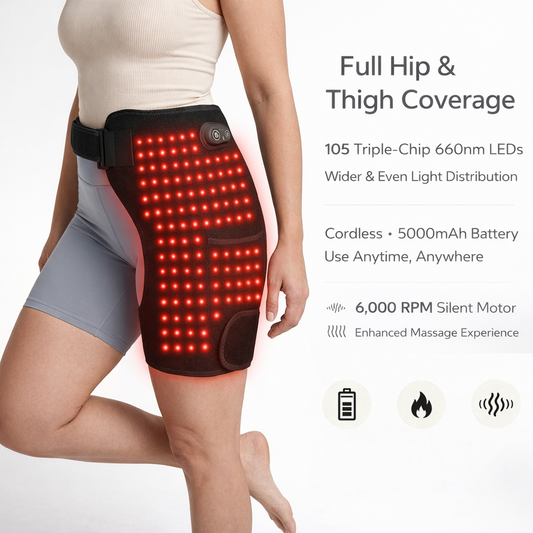
One example is the Nutvrliy Red Light Therapy Hip Wrap.
Rather than focusing on a single recovery method, it combines several complementary features into one wearable design:
- 105 triple-chip LEDs designed to provide broad 660nm red light coverage across the hip and upper thigh.
- Three adjustable heat levels (46°C, 57°C, and 65°C) to provide gentle, consistent warmth based on personal preference.
- Dual-motor vibration massage with three intensity modes to help reduce the feeling of muscle tightness after everyday activities.
- An ergonomic wrap with adjustable straps, allowing the device to remain comfortably in place while sitting, standing, or walking around the house.
- A rechargeable 5000mAh battery, enabling cordless use without being restricted by power cords.
These features are not intended to replace healthy recovery habits.
Instead, they are designed to make it easier to maintain them consistently.
For example, using gentle warmth before mobility exercises, combining vibration with an evening relaxation routine, or incorporating red light therapy into a regular recovery schedule may help turn occasional recovery into a sustainable daily habit.
Quick Take
Recovery tools work best when they support healthy habits—not when they replace them. A wearable hip wrap can make it easier to combine warmth, massage, and red light therapy into one consistent daily routine, especially for people who experience recurring hip or upper-thigh stiffness from everyday activities.
A Simple 20-Minute Hip Recovery Routine You Can Do at Home
One of the biggest misconceptions about recovery is that it requires a significant time commitment.
In reality, consistency matters far more than duration.
A recovery routine that fits naturally into your day is far more likely to become a lasting habit than an hour-long program that’s difficult to maintain.
If your hip discomfort is related to prolonged sitting, everyday muscle tightness, or post-exercise fatigue, the following routine provides a practical starting point.
Minute 0–3: Get Moving
Begin with light movement rather than stretching immediately.
Examples include:
- Walking around your home
- Walking outside for a few minutes
- Climbing a flight of stairs
- Marching gently in place
The goal isn’t exercise.
The goal is simply to increase circulation and encourage the hip joint to move through a comfortable range of motion.
Minute 3–8: Restore Mobility
Once the body is warm, add gentle mobility exercises.
Choose movements that feel comfortable.
Examples include:
- Hip circles
- Standing leg swings
- Knee-to-chest stretches
- Figure-four stretch
- Gentle hip flexor stretch
Stretching should never create sharp pain.
Instead, think of reducing stiffness rather than increasing flexibility.
Minute 8–18: Apply Heat While You Relax
Once mobility has improved, warmth can help maintain muscle relaxation.
This is where many people naturally incorporate a wearable recovery device.
For example, a wrap-style device that combines adjustable heat with vibration massage allows you to continue relaxing while reading, watching television, or preparing for bed instead of remaining attached to a traditional heating pad.
If you choose to include red light therapy as part of your routine, this is also a convenient time to use it.
A wearable device such as the Nutvrliy Red Light Therapy Hip Wrap combines several recovery features into a single session:
- Broad 660nm red light coverage across the hip and upper thigh through 105 triple-chip LEDs
- Three adjustable heat settings for personalized comfort
- Dual vibration motors with multiple massage modes
- An ergonomic wrap that stays comfortably in place during everyday activities
- A cordless 5000mAh rechargeable battery for flexible use around the home
Rather than replacing movement, these features are intended to complement it.
Many users find it easier to stay consistent when multiple recovery methods are combined into one routine instead of using several separate devices.
Minute 18–20: Finish With Easy Walking
Before returning to work or sitting for an extended period, spend another two minutes walking slowly.
This helps your body transition naturally back into everyday movement.
Recovery isn’t about becoming perfectly still.
It’s about helping your body move comfortably again.
Recovery Looks Different for Different People
There isn’t one “best” recovery routine.
Your daily habits should reflect how your hips are being used.
If You Sit Most of the Day
Office workers often develop stiffness because the hips remain flexed for prolonged periods.
Focus on:
- Standing every 30–60 minutes
- Short walking breaks
- Gentle hip mobility
- Evening heat therapy
- Consistent stretching before bed
Small interruptions to sitting time often have a greater long-term impact than one long workout after work.
If You Exercise Regularly
For runners, cyclists, and strength-training enthusiasts, recovery should support—not replace—training.
Prioritize:
- Adequate sleep
- Hydration
- Protein intake
- Active recovery days
- Gentle mobility work
- Heat or massage after intense sessions when appropriate
Remember that soreness is not always a sign of progress.
Good recovery helps prepare your body for the next session.
If You’re an Older Adult
As we age, joint mobility naturally changes.
Daily movement becomes increasingly important.
Choose activities such as:
- Walking
- Swimming
- Stationary cycling
- Chair exercises
- Gentle flexibility routines
Supportive recovery tools may also improve comfort during daily activities, making it easier to stay physically active.
Remaining active is one of the best long-term investments in maintaining mobility and independence.
Frequently Asked Questions
What is the fastest way to relieve hip pain?
For everyday muscular stiffness, the quickest approach is often a combination of gentle movement, appropriate heat, and avoiding prolonged sitting.
If pain follows a recent injury or is accompanied by swelling, cold therapy may be more appropriate during the first 24–48 hours.
Persistent, severe, or unexplained pain should always be evaluated by a healthcare professional.
Is heat better than ice for hip pain?
Neither is universally better.
Ice is generally recommended for recent injuries with swelling, while heat is commonly used for muscle tightness, stiffness, and chronic discomfort.
Choosing the right option depends on the underlying cause rather than the location of the pain.
Does red light therapy work for hip discomfort?
Photobiomodulation (red light therapy) is an active area of research.
Studies suggest that specific wavelengths—particularly those between approximately 630 and 850nm—may support normal cellular function and recovery under appropriate conditions.
However, red light therapy should be viewed as one component of a comprehensive recovery plan rather than a standalone solution.
Can I use a wearable hip wrap every day?
For healthy adults, wearable recovery wraps designed for home wellness are commonly used as part of a daily recovery routine.
Following the manufacturer’s instructions regarding session duration and heat settings is recommended.
If you have an underlying medical condition or are unsure whether heat or light therapy is appropriate for you, consult your healthcare provider first.
When should I see a doctor?
Seek medical attention immediately if hip pain:
- Occurs after a significant fall or accident
- Prevents you from bearing weight
- Is associated with severe swelling or deformity
- Is accompanied by fever
- Causes numbness or sudden weakness in the leg
If discomfort persists for several weeks despite self-care, professional evaluation is also recommended.
Key Takeaways
Hip pain is common, but the fastest path to relief is rarely a single treatment.
For many people experiencing everyday muscular discomfort or stiffness, combining several evidence-informed strategies offers the best results:
- Keep moving instead of sitting for prolonged periods.
- Use gentle mobility exercises to restore comfortable movement.
- Apply heat when stiffness limits flexibility.
- Consider massage or vibration to help reduce the feeling of muscle tension.
- Incorporate red light therapy as part of a broader recovery routine if appropriate.
- Stay consistent with daily habits rather than relying on occasional intensive treatments.
Recovery isn’t about finding a miracle solution.
It’s about making small, sustainable choices that help your body feel and move better over time.
Whether that’s taking a short walk after work, stretching before bed, or using a wearable recovery wrap that combines heat, vibration massage, and broad-area red light therapy, the goal remains the same: supporting comfortable movement so you can continue doing the activities you enjoy.
References
Clinical Guidelines
1. World Health Organization - WHO Guidelines on Physical Activity and Sedentary Behaviour
Official Guideline:
https://www.who.int/publications/i/item/9789240015128
PubMed:
https://pubmed.ncbi.nlm.nih.gov/33369898/
Open Access Full Text:
https://www.ncbi.nlm.nih.gov/books/NBK566045/
2. U.S. Department of Health and Human Services - Physical Activity Guidelines for Americans (2nd Edition)
Official Guideline:
https://health.gov/our-work/nutrition-physical-activity/physical-activity-guidelines
3. American Academy of Orthopaedic Surgeons (AAOS) - Hip Pain
Official Guideline:
https://orthoinfo.aaos.org/
4. National Institute for Health and Care Excellence (NICE) - Osteoarthritis in Over 16s: Diagnosis and Management
Official Guideline:
https://www.nice.org.uk/guidance/ng226
5. Mayo Clinic - Hip Pain
Official Guideline:
https://www.mayoclinic.org/symptoms/hip-pain/basics/definition/sym-20050684
Sedentary Behavior & Physical Activity
6. Owen N, Healy GN, Matthews CE, Dunstan DW. - Too Much Sitting: The Population-Health Science of Sedentary Behavior
Journal:
Exercise and Sport Sciences Reviews. 2010.
PubMed:
https://pubmed.ncbi.nlm.nih.gov/20577058/
DOI:
https://doi.org/10.1097/JES.0b013e3181e373a2
7. Ekelund U, Steene-Johannessen J, Brown WJ, et al. - Does Physical Activity Attenuate, or Even Eliminate, the Detrimental Association of Sitting Time With Mortality?
Journal:
The Lancet. 2016.
PubMed:
https://pubmed.ncbi.nlm.nih.gov/27475271/
DOI:
https://doi.org/10.1016/S0140-6736(16)30370-1
8. Warburton DER, Bredin SSD. - Health Benefits of Physical Activity: A Systematic Review of Current Systematic Reviews
Journal:
Current Opinion in Cardiology. 2017.
PubMed:
https://pubmed.ncbi.nlm.nih.gov/28708630/
DOI:
https://doi.org/10.1097/HCO.0000000000000437
Heat Therapy
9. French SD, Cameron M, Walker BF, et al. - Superficial Heat or Cold for Low Back Pain
Journal:
Cochrane Database of Systematic Reviews.
PubMed:
https://pubmed.ncbi.nlm.nih.gov/25520913/
DOI:
https://doi.org/10.1002/14651858.CD004750.pub4
10. Nadler SF. - Nonpharmacologic Management of Pain
Journal:
Journal of the American Osteopathic Association.
PubMed:
https://pubmed.ncbi.nlm.nih.gov/16451066/
Massage & Recovery
11. Dupuy O, Douzi W, Theurot D, Bosquet L, Dugué B. - An Evidence-Based Approach for Choosing Recovery Techniques After Exercise
Journal:
Frontiers in Physiology.
PubMed:
https://pubmed.ncbi.nlm.nih.gov/29467669/
DOI:
https://doi.org/10.3389/fphys.2018.00403
Open Access Full Text:
https://www.frontiersin.org/articles/10.3389/fphys.2018.00403/full
12. Cheatham SW, Kolber MJ, Cain M, Lee M. - The Effects of Self-Myofascial Release Using a Foam Roll or Roller Massager on Joint Range of Motion, Muscle Recovery, and Performance
Journal:
International Journal of Sports Physical Therapy.
PubMed:
https://pubmed.ncbi.nlm.nih.gov/26618062/
Open Access Full Text:
https://ijspt.scholasticahq.com/article/21021
13. Davis HL, Alabed S, Chico TJA. - Effect of Massage Therapy on Pain and Function: Systematic Review
Journal:
BMJ Open.
PubMed:
https://pubmed.ncbi.nlm.nih.gov/
Open Access Full Text:
https://bmjopen.bmj.com/
Red Light Therapy (Photobiomodulation)
14. Hamblin MR. - Mechanisms and Applications of the Anti-inflammatory Effects of Photobiomodulation
Journal:
AIMS Biophysics.
PubMed:
https://pubmed.ncbi.nlm.nih.gov/28507346/
Open Access Full Text:
https://www.ncbi.nlm.nih.gov/pmc/articles/PMC5523874/
15. Hamblin MR. - Photobiomodulation for Musculoskeletal Disorders
Journal:
Photobiomodulation, Photomedicine, and Laser Surgery.
PubMed:
https://pubmed.ncbi.nlm.nih.gov/
16. Bjordal JM, Johnson MI, Iversen V, et al. - Low-Level Laser Therapy in Acute Pain
Journal:
The Lancet.
PubMed:
https://pubmed.ncbi.nlm.nih.gov/19913903/
DOI:
https://doi.org/10.1016/S0140-6736(09)61658-6
17. Chow RT, Johnson MI, Lopes-Martins RAB, et al. - Efficacy of Low-Level Laser Therapy in Neck Pain
Journal:
The Lancet.
PubMed:
https://pubmed.ncbi.nlm.nih.gov/19833328/
DOI:
https://doi.org/10.1016/S0140-6736(09)61522-1
18. de Freitas LF, Hamblin MR. - Proposed Mechanisms of Photobiomodulation
Journal:
IEEE Journal of Selected Topics in Quantum Electronics.
PubMed:
https://pubmed.ncbi.nlm.nih.gov/28070154/
Open Access Full Text:
https://www.ncbi.nlm.nih.gov/pmc/articles/PMC5215870/
19. Anders JJ, Lanzafame RJ, Arany PR. - Low-Level Light/Laser Therapy Versus Photobiomodulation Therapy
Journal:
Photomedicine and Laser Surgery.
PubMed:
https://pubmed.ncbi.nlm.nih.gov/27834568/
Sleep & Recovery
20. Fullagar HHK, Skorski S, Duffield R, et al. - Sleep and Athletic Performance
Journal:
Sports Medicine.
PubMed:
https://pubmed.ncbi.nlm.nih.gov/25868771/
DOI:
https://doi.org/10.1007/s40279-015-0305-7
21. Halson SL. - Sleep in Elite Athletes and Nutritional Interventions to Enhance Sleep
Journal:
Sports Medicine.
PubMed:
https://pubmed.ncbi.nlm.nih.gov/24477654/
DOI:
https://doi.org/10.1007/s40279-014-0147-0
Nutrition & Hydration
22. Thomas DT, Erdman KA, Burke LM. - Nutrition and Athletic Performance
Journal:
Journal of the Academy of Nutrition and Dietetics.
PubMed:
https://pubmed.ncbi.nlm.nih.gov/27886704/
DOI:
https://doi.org/10.1016/j.jand.2015.12.006
23. Sawka MN, Burke LM, Eichner ER, et al. - Exercise and Fluid Replacement
Journal:
Medicine & Science in Sports & Exercise.
PubMed:
https://pubmed.ncbi.nlm.nih.gov/17277604/
DOI:
https://doi.org/10.1249/mss.0b013e31802ca597
Hip Pain
24. Reiman MP, Goode AP, Cook CE, et al. - Diagnostic Accuracy of Clinical Tests for Hip Disorders
Journal:
British Journal of Sports Medicine.
PubMed:
https://pubmed.ncbi.nlm.nih.gov/23864178/
DOI:
https://doi.org/10.1136/bjsports-2012-091035
25. Kemp JL, Mosler AB, Hart HF, et al. - Improving Function in People With Hip-related Pain
Journal:
British Journal of Sports Medicine.
PubMed:
https://pubmed.ncbi.nlm.nih.gov/