Treatment for Bursitis of the Hip: Evidence-Based Options to Reduce Pain and Improve Mobility
Share
Hip Pain Isn’t Always Coming From the Joint
A surprising number of people assume pain on the outside of the hip means they have arthritis.
It often doesn’t.
If you’ve ever felt a sharp ache while lying on one side, climbing stairs, getting out of the car, or walking after sitting for a while, the source of your discomfort may not be the hip joint itself. Instead, it may involve a small fluid-filled structure designed to reduce friction every time you move.
This structure is called a bursa.
When it becomes irritated, everyday movements that once felt effortless can suddenly become frustrating.
Reaching the top step of a staircase.
Rolling over in bed.
Standing after a long meeting.
Crossing your legs.
None of these activities place extraordinary demands on the body, yet they can become surprisingly uncomfortable when the tissues around the outside of the hip become sensitive.
For many years, this type of pain was commonly described as hip bursitis.
Today, specialists recognize that pain around the greater trochanter is often more complex than inflammation of the bursa alone. Modern research increasingly uses the term Greater Trochanteric Pain Syndrome (GTPS) because nearby tendons—particularly the gluteus medius and gluteus minimus—are frequently involved alongside the bursa.
That distinction matters.
Not because the name changes your symptoms, but because it changes how clinicians think about treatment.
Rather than focusing on one inflamed structure, current approaches emphasize improving movement, reducing excessive loading, restoring strength, and helping people gradually return to normal activities.
This article explores what current evidence says about treatment for bursitis of the hip, including conservative care, exercise, heat, photobiomodulation, and practical recovery strategies that can fit into everyday life.
What Is Hip Bursitis?
Your body contains more than 150 bursae.
These small sacs are filled with a thin layer of fluid and act like cushions between bones, tendons, muscles, and ligaments. Their job is simple: reduce friction during movement.
Around the hip, several bursae help soft tissues glide smoothly as you walk, climb stairs, or stand up from a chair.
The bursa most commonly associated with outer hip pain sits over the greater trochanter, the prominent bony point on the outside of the femur.
When this area becomes irritated, movements that repeatedly load the outer hip can become uncomfortable.
However, advances in imaging have changed our understanding of the condition.
Magnetic resonance imaging (MRI) and ultrasound studies have shown that many people diagnosed with “trochanteric bursitis” also have changes involving the surrounding tendons.
Because of this, clinicians increasingly use the broader term Greater Trochanteric Pain Syndrome, recognizing that pain may arise from a combination of bursae, tendons, muscles, and surrounding soft tissues rather than a single inflamed structure.
The important takeaway for patients is reassuring:
Whether the discomfort is labeled hip bursitis or GTPS, many of the recommended conservative management strategies remain similar.
How Common Is Hip Bursitis?
Lateral hip pain is one of the most common causes of chronic hip discomfort in adults.
Population-based studies estimate that Greater Trochanteric Pain Syndrome affects approximately 10% to 25% of adults, depending on the population being studied.
Women are diagnosed considerably more often than men.
Several large observational studies suggest the condition is two to four times more common in women, particularly between the ages of 40 and 60.
Researchers believe differences in pelvic anatomy, tendon loading, hormonal influences, and biomechanics may all contribute to this increased risk, although no single explanation fully accounts for the difference.
Certain lifestyle and medical factors also appear to increase the likelihood of developing persistent lateral hip pain, including:
- Repetitive walking or running on uneven surfaces.
- Weakness of the hip abductor muscles.
- Previous lower back pain.
- Knee osteoarthritis.
- Obesity.
- Long periods of standing.
- Sleeping on the same side every night.
Importantly, hip bursitis is not simply a condition affecting runners or athletes.
Many people develop symptoms through years of ordinary daily activities rather than one dramatic injury.
What Causes Hip Bursitis?
One of the biggest misconceptions is that hip bursitis develops because the bursa suddenly becomes inflamed for no reason.
In reality, symptoms often develop gradually.
Every time you walk, your gluteal tendons slide over the outside of the greater trochanter.
Normally, the bursa helps these tissues move smoothly.
But when the surrounding muscles become weaker, movement patterns change, or repetitive loading increases, the tissues around the hip may become more sensitive over time.
Several factors are commonly associated with this process.
Repetitive Loading
Long-distance walking, running, hiking, or climbing stairs repeatedly can increase stress around the outside of the hip, particularly when training volume increases faster than the body can adapt.
Weak Hip Muscles
The gluteus medius plays a crucial role in stabilizing the pelvis while walking.
When these muscles become weaker, the mechanics around the hip change.
Instead of sharing forces efficiently, the tendons and surrounding tissues may experience greater compression against the bony prominence of the greater trochanter.
For many people, strengthening these muscles becomes an important part of long-term management.
Prolonged Compression
One of the simplest—but often overlooked—contributors is prolonged pressure on the outside of the hip.
Sleeping on the painful side every night, crossing the legs for extended periods, or standing with most of your weight shifted onto one hip may increase compression of already sensitive tissues.
These habits don’t necessarily cause hip bursitis on their own.
However, reducing prolonged compression is frequently recommended as part of conservative care.
Previous Injuries
Changes elsewhere in the body can influence the hip.
People recovering from knee injuries, ankle problems, or lower back pain sometimes alter the way they walk without realizing it.
Over weeks or months, these subtle changes in movement can gradually increase stress around the lateral hip.
The body is remarkably adaptable—but compensation isn’t always efficient.
Sitting Isn’t the Problem—Staying Still Is
Many office workers worry that sitting itself causes hip bursitis.
Current evidence suggests the issue is more nuanced.
The problem isn’t simply sitting.
It’s spending long periods in one position without changing how the hips move.
Standing up regularly, taking short walks, and moving through comfortable ranges of motion throughout the day can help reduce prolonged stiffness around the hips and lower back.
Evidence-Based Treatment for Bursitis of the Hip
If you’ve been searching online, you’ve probably noticed there’s no shortage of advice.
Rest completely.
Stretch more.
Don’t stretch.
Use ice.
Use heat.
Get an injection.
Try massage.
It’s easy to come away feeling more confused than when you started.
The good news is that most modern clinical guidelines follow a similar principle:
Hip bursitis—or more accurately, Greater Trochanteric Pain Syndrome—is usually managed conservatively before more invasive treatments are considered.
That doesn’t mean doing just one thing.
Instead, treatment typically combines several strategies that work together to reduce irritation, restore movement, and gradually improve function.
Rather than asking, “What’s the one best treatment?”, clinicians are more likely to ask:
“Which combination of treatments best fits this person’s symptoms, activity level, and stage of recovery?”
1. Modify Activities—Don’t Stop Moving
When hip pain begins, many people respond in one of two ways.
They either push through the pain and keep doing everything exactly the same.
Or they stop moving almost completely.
Neither approach is ideal.
Current rehabilitation guidelines generally recommend modifying activities instead of eliminating movement altogether.
For example, if climbing five flights of stairs repeatedly aggravates your symptoms, taking the elevator for a few days may allow irritated tissues to settle without reducing your overall activity level.
If running causes pain but walking does not, temporarily replacing high-impact exercise with lower-impact activities can help maintain fitness while reducing stress on the lateral hip.
The goal isn’t long-term rest.
It’s giving sensitive tissues an opportunity to calm down while keeping the rest of the body active.
2. Strengthening Often Matters More Than Stretching
For years, people with lateral hip pain were commonly told to stretch more.
Today, rehabilitation research tells a more complete story.
Many specialists now place greater emphasis on strengthening the muscles that stabilize the pelvis, particularly the gluteus medius and gluteus minimus.
These muscles help control the position of the pelvis every time you take a step.
When they become weaker or fatigue easily, the tendons around the greater trochanter may experience higher compressive forces during everyday movement.
Several clinical studies have shown that structured exercise programs focused on progressive hip strengthening can improve pain and physical function in people with Greater Trochanteric Pain Syndrome.
Simple exercises often recommended by physical therapists include:
- Side-lying hip abduction
- Clamshells
- Glute bridges
- Standing hip abduction with a resistance band
- Single-leg balance exercises
Notice that none of these exercises are particularly dramatic.
That’s because successful rehabilitation usually depends more on consistency and gradual progression than intensity.
3. Reduce Compression Around the Hip
One concept receiving increasing attention is compression.
Many people assume pain is caused only by movement.
In reality, prolonged pressure against irritated tissues can be just as important.
This explains why sleeping on the painful side is often uncomfortable.
It also explains why standing with your weight shifted onto one hip or crossing your legs for long periods may aggravate symptoms.
Small adjustments can reduce unnecessary compression without limiting normal daily activities.
Examples include:
- Sleeping on the opposite side with a pillow between the knees.
- Avoiding prolonged side-lying on the painful hip.
- Standing with weight distributed evenly between both legs.
- Changing sitting positions regularly throughout the day.
These changes won’t cure hip bursitis.
But they may reduce repeated irritation while the tissues recover.
Heat or Ice: Which One Should You Choose?
One of the most common questions people ask is surprisingly simple:
“Should I use ice or heat?”
The answer depends on what you’re trying to accomplish.
Ice
Cold therapy is generally recommended when symptoms are associated with recent irritation or a noticeable increase in pain following activity.
Applying a cold pack for about 15 to 20 minutes may help reduce discomfort after activities that temporarily aggravate symptoms.
Ice is commonly used during the early stages of an acute flare-up—not because it “repairs” tissue, but because it may help calm a temporarily irritated area.
Heat
Heat serves a different purpose.
Instead of addressing an acute flare, warmth is often used to help muscles relax and prepare the body for movement.
Many people notice that the hip feels particularly stiff after sitting for several hours or first thing in the morning.
Gentle warmth before walking, stretching, or performing rehabilitation exercises may help movement feel more comfortable.
It’s important to set realistic expectations.
Heat doesn’t eliminate the underlying cause of hip bursitis.
Instead, it can be one component of a broader recovery routine designed to improve comfort before activity.
Why Recovery Is More Than Pain Relief
One reason people become frustrated with hip pain is that they judge every strategy by a single question:
“Does it make the pain disappear?”
Recovery is usually more gradual than that.
A useful recovery routine aims to support several goals at the same time:
- Helping muscles relax before exercise.
- Making movement feel more comfortable.
- Encouraging consistent daily mobility.
- Reducing stiffness after prolonged sitting.
- Supporting adherence to rehabilitation exercises.
In other words, recovery isn’t only about reducing today’s discomfort.
It’s about making tomorrow’s movement easier.
That shift in mindset often changes which tools people choose to include in their daily routine.
Bringing Multiple Recovery Strategies Together
Traditionally, many people have relied on separate tools for different parts of their recovery.
A heating pad for warmth.
A handheld massager for tight muscles.
A clinic visit for light-based therapy.
As wearable recovery technology has evolved, these approaches are increasingly being combined into a single routine—not because one modality replaces another, but because consistency becomes easier when fewer steps are involved.
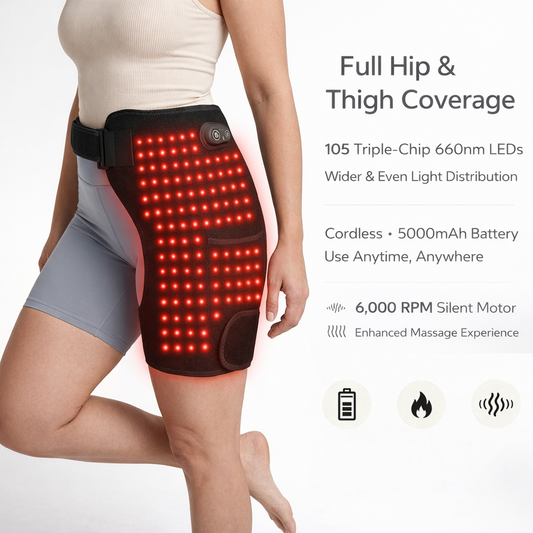
One example is a wearable hip recovery wrap that combines red and near-infrared light, adjustable heat, and vibration massage into a single cordless device.
The idea isn’t to replace rehabilitation exercises or professional medical care.
Instead, it supports the period before or after movement, when many people are trying to relax stiff muscles and prepare for or recover from activity.
The Nutvrliy Red Light Therapy Hip Wrap follows this approach.
Its design reflects several principles commonly used in conservative recovery routines:
- Broad treatment coverage across the lateral hip and upper thigh using 105 LEDs arranged in a triple-chip configuration, helping deliver light more evenly than smaller spot-treatment devices.
- 660nm red light, a wavelength widely used in photobiomodulation research involving superficial soft tissues.
- Three adjustable heat settings (46°C, 57°C, and 65°C) that allow users to select a comfortable level of warmth before stretching or relaxation.
- Dual-motor vibration with three intensity levels to create a gentle massage experience that may help ease the sensation of muscle tightness after prolonged sitting or daily activity.
- A lightweight cordless design powered by a 5000mAh rechargeable battery, making it easier to incorporate short recovery sessions into everyday routines without remaining connected to a wall outlet.
Rather than being presented as a treatment for hip bursitis itself, wearable recovery devices like this are best understood as tools that may help people stay consistent with recovery habits—especially when used alongside appropriate exercise, activity modification, and professional guidance when needed.
What Does Current Research Say About Red Light Therapy?
If you’ve looked into non-drug options for managing musculoskeletal discomfort, you’ve probably come across red light therapy—sometimes referred to in scientific literature as photobiomodulation (PBM).
Over the past two decades, photobiomodulation has attracted growing interest across sports medicine, rehabilitation, and physical therapy. Researchers have explored its potential role in a wide range of musculoskeletal conditions, including tendinopathy, osteoarthritis, muscle fatigue, delayed-onset muscle soreness (DOMS), and soft tissue recovery.
Hip bursitis, however, deserves a more nuanced discussion.
At present, there is limited high-quality research specifically investigating photobiomodulation for greater trochanteric pain syndrome (GTPS) or trochanteric bursitis. Most of the available evidence comes from studies involving related musculoskeletal conditions rather than the hip bursa itself.
That distinction is important.
Rather than viewing red light therapy as a stand-alone treatment for hip bursitis, many rehabilitation professionals consider it one of several supportive recovery modalities that may be incorporated into a broader conservative management plan.
Current evidence is encouraging in some areas, but it should also be interpreted with appropriate expectations.
Why Are 660nm and 850nm Commonly Used?
One question that often comes up is why so many wearable recovery devices combine 660nm red light with 850nm near-infrared light instead of using only one wavelength.
The answer lies in how different wavelengths interact with biological tissues.
Visible red light around 660 nanometers is generally absorbed within more superficial layers of the skin and soft tissue.
Near-infrared light around 850 nanometers penetrates deeper beneath the surface because it scatters differently within tissue.
Rather than competing with one another, these wavelengths are frequently paired to provide broader coverage across tissues located at different depths.
This is one reason dual-wavelength systems have become increasingly common in rehabilitation clinics and home recovery devices.
It’s worth emphasizing that deeper penetration does not automatically mean better clinical outcomes. Tissue response depends on many variables, including treatment parameters, dosage, individual physiology, and the underlying condition being addressed.
For this reason, researchers continue to investigate how different wavelengths and treatment protocols may influence specific musculoskeletal disorders.
Why Treatment Area Matters
Another practical consideration is coverage.
Many early home-use red light devices were designed to treat small, localized areas. While that may be appropriate for fingers, wrists, or other compact joints, the hip presents a different challenge.
The lateral hip is not a small target.
Discomfort may involve the greater trochanter, surrounding gluteal tendons, upper thigh muscles, and nearby soft tissues. Because these structures work together during walking and standing, recovery routines often focus on the region rather than a single point.
For this reason, some wearable devices have shifted away from small spot-treatment panels toward broader illumination across the hip and upper thigh.
One example is the Nutvrliy Red Light Therapy Hip Wrap, which incorporates 105 LEDs arranged in a triple-chip configuration to distribute light across a wider treatment area than many compact handheld devices.
The goal of this design is not to “treat bursitis” directly.
Instead, broader coverage may better match the anatomy of the hip region, where several muscles and connective tissues contribute to comfortable movement.
Why Heat and Movement Often Go Hand in Hand
One of the most overlooked parts of hip recovery isn’t what happens during exercise.
It’s what happens before exercise.
People experiencing lateral hip pain frequently describe the first few steps after sitting as the most uncomfortable part of the day.
This is where gentle warmth can be useful.
Heat has long been used in rehabilitation settings to help muscles feel more relaxed before movement. While it does not correct the underlying mechanical factors contributing to hip pain, many people find that comfortable warmth makes stretching and strengthening exercises feel easier to perform.
That matters because rehabilitation exercises are most effective when people actually continue doing them.
A routine that feels uncomfortable is a routine that is often abandoned.
A routine that feels manageable is much more likely to become a habit.
Building a Recovery Routine That Fits Everyday Life
One challenge with rehabilitation is that consistency is difficult.
Physical therapy exercises may only take fifteen minutes.
Finding fifteen uninterrupted minutes every day is another story.
That’s one reason wearable recovery tools have become increasingly popular—not because they replace exercise, but because they can fit into time people are already using.
Reading after dinner.
Watching a television program.
Answering emails.
Relaxing before bed.
Rather than asking someone to create another task, recovery becomes part of an existing routine.
The Nutvrliy Red Light Therapy Hip Wrap was designed with this kind of everyday use in mind.
Its ergonomic wrap contours around the hip and upper thigh, allowing the device to stay comfortably in place while sitting or resting. A 5000mAh rechargeable battery provides cordless operation, making it practical to use in different environments without remaining close to a power outlet.
The wrap also combines three adjustable heat levels (46°C, 57°C, and 65°C) with dual-motor vibration, allowing users to tailor the experience according to personal comfort preferences. Rather than viewing each feature as a separate therapy, many people simply incorporate them into a short evening recovery session before performing gentle mobility exercises or preparing for sleep.
The emphasis is not on replacing evidence-based rehabilitation.
It’s on making supportive recovery habits easier to repeat consistently.
Recovery Is About Momentum, Not Perfection
One misconception about recovery is that every session has to be perfect to make a difference.
In reality, long-term musculoskeletal health is usually shaped by consistency rather than intensity.
Missing one stretching session isn’t what leads to persistent stiffness.
Ignoring shoulder or hip mobility for months often has a much greater impact.
The same principle applies to lateral hip pain.
People who maintain regular movement, gradually rebuild strength, avoid prolonged compression, and develop recovery habits they can realistically sustain are generally in a better position than those who rely on occasional bursts of aggressive exercise.
Whether that routine includes walking, strengthening exercises, heat, massage, or wearable recovery technologies matters less than whether it becomes something you can comfortably maintain over time.
After all, the goal isn’t simply to feel better today.
It’s to keep moving comfortably tomorrow, next month, and years from now.
A Practical Daily Recovery Routine for Hip Bursitis
One of the most reassuring things about conservative care is that it doesn’t usually depend on a single treatment session.
Instead, improvement often comes from small actions repeated consistently.
That doesn’t mean spending an hour every day on rehabilitation.
For many people, a simple routine that fits naturally into everyday life is much easier to maintain—and far more likely to become a long-term habit.
Here’s an example.
Morning: Wake the Hip Up
After several hours of sleep, it’s common for the hip to feel stiff during the first few steps.
Rather than immediately sitting down again or rushing into a busy morning, spend a few minutes gently preparing the joint for movement.
A short walk around the house.
Hip circles.
Standing hip abduction.
A few controlled glute activation exercises.
The goal isn’t to work up a sweat.
It’s simply to remind the muscles around the hip to begin working together again.
Throughout the Day: Keep Changing Positions
One of the simplest ways to reduce prolonged loading around the lateral hip is surprisingly easy.
Don’t stay in the same position for too long.
If you work at a desk, stand every hour.
If you drive for long periods, take short walking breaks whenever possible.
If you naturally shift your weight onto one leg while standing, consciously alternate sides.
These small adjustments don’t require special equipment.
Yet over time they can reduce the repetitive compression that often aggravates lateral hip pain.
Evening: Prepare Your Body Before Rest
Many people notice their hip feels most uncomfortable after the day’s activities have accumulated.
This is often a good time to shift the focus from activity to recovery.
A short session of gentle strengthening or mobility exercises can be followed by comfortable warmth while reading, watching television, or winding down for the evening.
Some people also choose to incorporate wearable recovery tools that combine several supportive modalities into one routine.
For example, the Nutvrliy Red Light Therapy Hip Wrap is designed to wrap comfortably around the lateral hip and upper thigh, allowing users to relax while the device provides 660nm red light, adjustable warmth, and gentle vibration massage.
Its 105-LED triple-chip layout distributes light across a broader area than many compact spot-treatment devices, while the cordless rechargeable battery allows the wrap to be used comfortably at home without remaining connected to a power outlet.
Rather than replacing exercise or professional treatment, tools like these are often used before mobility exercises or during evening relaxation, helping users build a recovery routine they can realistically maintain.
Ultimately, the value of any recovery tool isn’t measured by the number of features it includes.
It’s measured by whether it encourages people to stay consistent with healthy habits.
When Should You See a Healthcare Professional?
Although many cases of lateral hip pain improve with conservative management, persistent or worsening symptoms deserve professional attention.
Arrange a medical evaluation if you experience:
- Hip pain that continues for several weeks despite activity modification.
- Difficulty walking because of increasing pain.
- Significant swelling, redness, or warmth around the hip.
- Pain following a fall or other traumatic injury.
- Fever or unexplained weight loss together with hip pain.
- Numbness, weakness, or symptoms extending below the knee.
These symptoms don’t necessarily indicate hip bursitis.
Conditions such as hip osteoarthritis, stress fractures, lumbar spine disorders, tendon tears, or other musculoskeletal problems can produce similar symptoms and require different treatment strategies.
An accurate diagnosis is always the first step toward choosing the most appropriate management plan.
Frequently Asked Questions
Can Hip Bursitis Heal Without Surgery?
Yes.
The majority of people improve with conservative treatment.
Current clinical guidelines generally recommend beginning with activity modification, progressive strengthening exercises, and physical therapy before considering more invasive options.
Surgery is uncommon and is typically reserved for persistent cases that have not responded to appropriate non-surgical care.
Is Walking Good for Hip Bursitis?
For many people, yes.
Walking is usually encouraged as long as it does not significantly increase symptoms.
If walking causes pain, reducing distance temporarily or choosing flatter surfaces may help while recovery progresses.
The goal is to remain active without repeatedly overloading irritated tissues.
Should I Stretch Every Day?
Gentle mobility exercises can be helpful, but stretching should never create sharp pain.
Many rehabilitation programs place greater emphasis on gradually strengthening the hip abductors and improving movement quality than on aggressive stretching alone.
Is Heat Better Than Ice?
Neither is universally better.
Ice is often used after activities that temporarily increase discomfort.
Heat is commonly used before movement or in the evening to help muscles feel more relaxed.
Many people find they use both at different stages of recovery depending on how the hip feels that day.
Can Massage Help Hip Bursitis?
Massage may help reduce the feeling of muscle tightness surrounding the hip, particularly in the gluteal muscles and upper thigh.
However, massage is generally considered a supportive recovery strategy rather than a primary treatment for Greater Trochanteric Pain Syndrome.
It is often combined with strengthening exercises, activity modification, and other conservative approaches.
Can Red Light Therapy Be Used as Part of a Hip Recovery Routine?
Photobiomodulation has been studied in a variety of musculoskeletal conditions, and interest in home-use devices continues to grow.
Although evidence specific to hip bursitis remains limited, some people choose to incorporate red and near-infrared light therapy into their overall recovery routine alongside exercise, movement, and physical therapy.
Wearable devices such as the Nutvrliy Red Light Therapy Hip Wrap combine red light, adjustable heat, and vibration massage in a cordless format, making them a practical option for individuals who want to build a consistent evening recovery habit.
These devices should be viewed as complements to—not replacements for—evidence-based rehabilitation and medical care.
Key Takeaways
Hip bursitis is rarely caused by a single movement or one difficult day.
More often, it develops gradually through a combination of tissue sensitivity, repetitive loading, muscle weakness, and changes in movement over time.
The encouraging news is that most people improve without surgery.
Modern treatment focuses on helping people move better rather than simply move less.
Activity modification, progressive strengthening, reducing prolonged compression around the hip, and maintaining regular movement form the foundation of conservative care recommended by current clinical guidelines.
Supportive recovery strategies—including comfortable warmth, massage, and photobiomodulation—may also have a place within a broader rehabilitation plan when used appropriately and with realistic expectations.
Perhaps the most important lesson is this:
Recovery isn’t built during one perfect treatment session.
It’s built through consistent daily habits that make comfortable movement easier to maintain.
Whether that means walking a little farther, completing your strengthening exercises, or taking twenty minutes each evening to focus on recovery, those small choices often have the greatest influence over how your hip feels in the weeks and months ahead.
Editor’s Note
Medical Disclaimer
This article is provided for educational purposes only and should not be considered medical advice. Hip pain can have many different causes, including greater trochanteric pain syndrome, osteoarthritis, tendon disorders, lumbar spine conditions, or fractures. Always consult a qualified healthcare professional for an accurate diagnosis and an individualized treatment plan. Do not delay seeking medical care if you experience severe pain, fever, inability to bear weight, significant swelling, or symptoms following trauma.